
Listening To Stories and Making Them Up


“Helicopter Stories is so powerful because children perceive it as play, not as a teacher-led activity.”
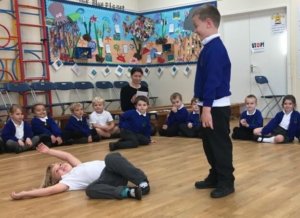
We have been using Helicopter Stories in St Paul’s Primary School, Chippenham, since 2017. We have a huge language deficit at our school, so our children tend to arrive with very poor speech and language skills. I think this is a universal reality now – partly because of Covid, and partly because of other national issues – but for us, it’s always been the case.
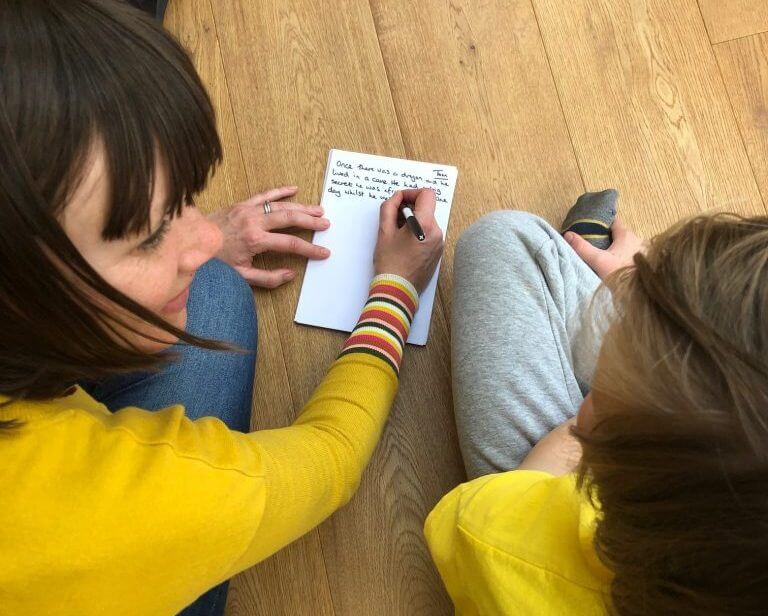
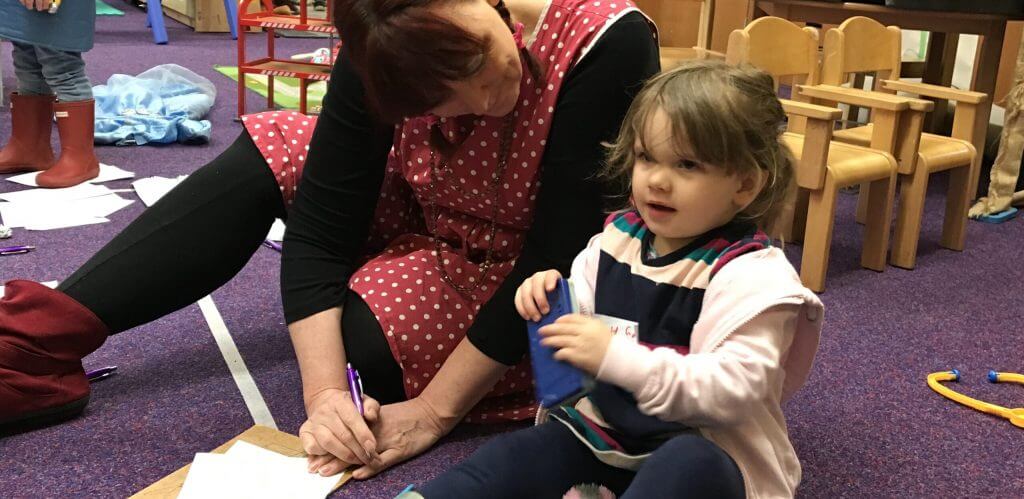
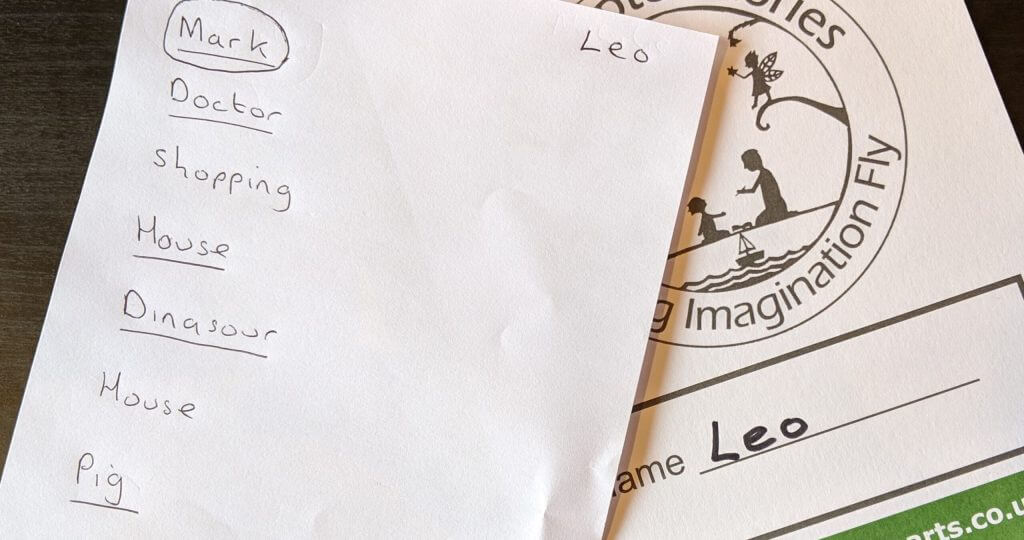
The speaking element of Helicopter Stories is so important, and I have seen almost instant progress. I think that’s because of modelling from the other children. You’ll have a child who’s just writing a list or a single character story in September, and it only takes them a few times of seeing another child’s more complex story get acted out before they’re telling more complex stories too. It’s motivational. I see children in my class push themselves each time to improve on their own stories. When you flick through their individual books across the year, you realise it’s rare to see such good progress across other areas of the curriculum in such a short amount of time.
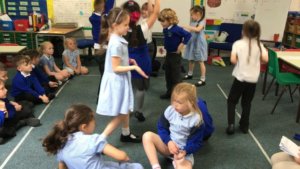
Helicopter Stories is so powerful because children perceive it as play, not as a teacher-led activity, which makes sense because children build neural pathways more quickly through play than formal learning. They’re lighting up different parts of their brain, helping them to learn vocabulary, sentence construction, grammar, tone of voice, intonation and beyond in a really fluid way. They’re never forced to do it, it’s always a choice.
Helicopter Stories is the biggest motivator in our class for children to write. For anyone target-driven and wanting to see reception children mark making or using initial sounds, there’s no need to do a phonics session because it’s already happening organically. We even have a TA dedicated to talking to the children about the stories they write independently.
I enjoy doing Helicopter Stories in a class that’s a mix of ages. The nature of Helicopter Stories is that children can access the approach at whatever level they’re at. You could have a group from Preschool to Year Two and it would still work as long as the children are equally familiar with the routine. The children enjoy the stories all the same, and they appreciate the author regardless; they get excited about acting out a list story from one child in the same way as they get excited about hearing a novel from another.
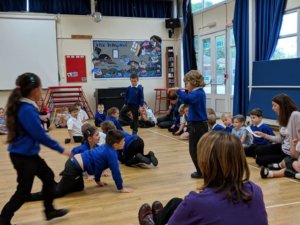
Once we had been doing Helicopter Stories for a while we started using The Story Basket. At first the children found it difficult to sit and listen to audio without images. Now they can recall the key events of the story, and have opinions about what the characters could have done.
Through The Story Basket, the children get exposed to new language and then translate it into their own stories, putting a creative spin on their favourite part and taking it in a new direction.
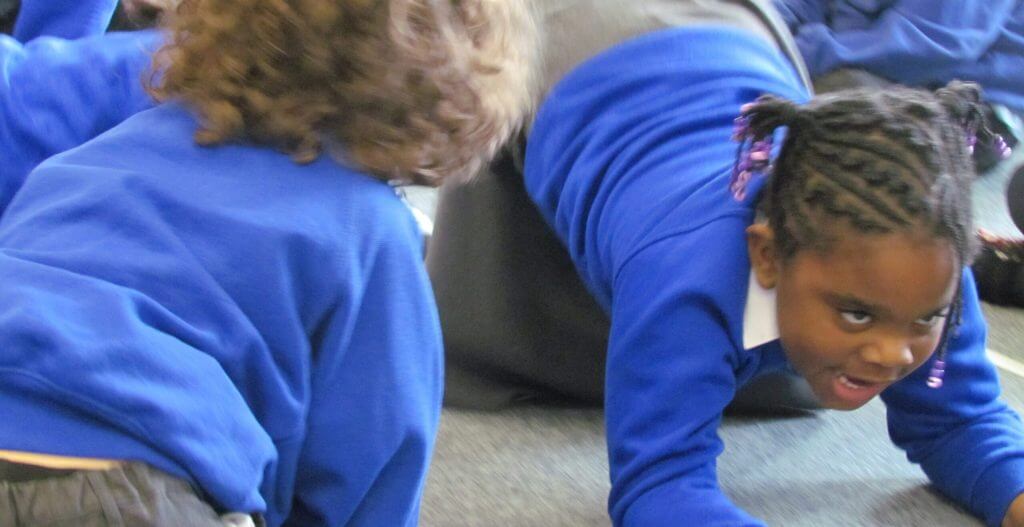
In the same way, the acting element of Helicopter Stories infiltrates The Story Basket, too. When we were listening to The Leaky Bucket recently, the children took to the stage and pretended to carry their buckets. Some of them were also pretending they were the water leaking out of the bucket. It was fantastic.
Helicopter Stories and The Story Basket are completely embedded in our school. I can’t imagine our classrooms without them.

Responses