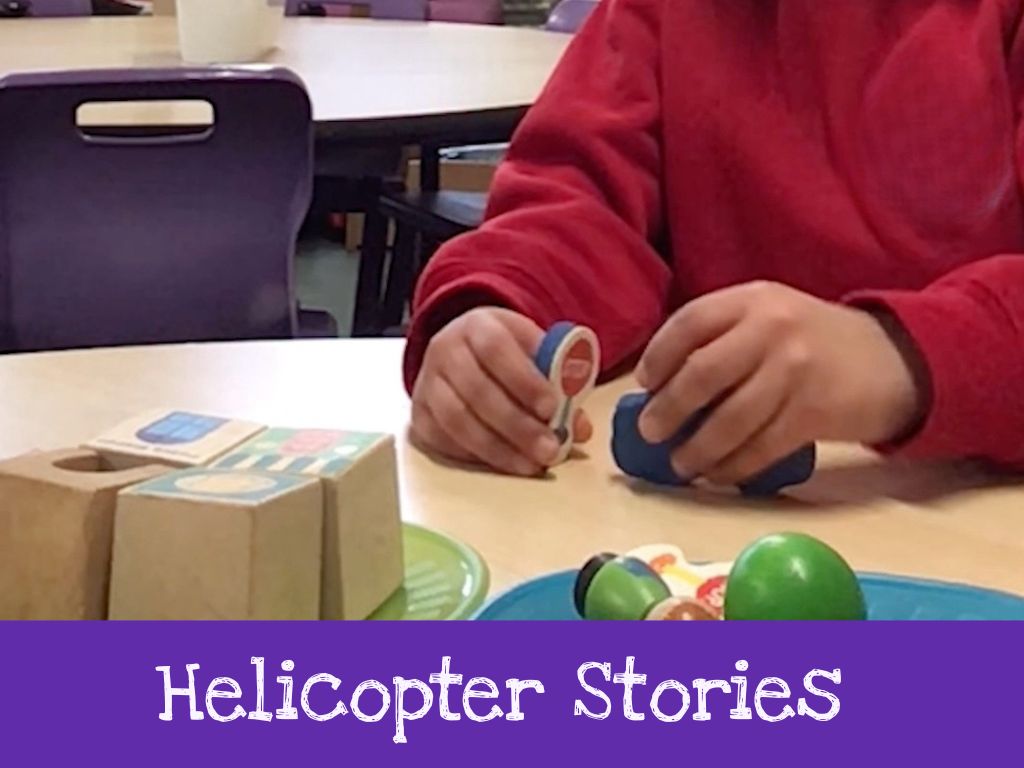
“That was the first time, I’d seen a non-verbal child return to his story and edit it. ‘There was a car and a girl and a train.’ When the boy added the figure of a girl she was standing up. Then the train came. The boy went back to the objects and knocked the girl over and laid her on the ground. He looked at me, and when I didn’t write it down, he stood the girl up, and then knocked her down again. What he meant was the girl had been knocked down by the train.”
Nicola Leyshon – SENCo, Lydgate Infant School
The Need:
At both Lydgate Infant School in Sheffield and Westhaven Special School in Somerset, teachers were searching for ways to give non-verbal children more agency with how they dictated their Helicopter Stories. Nicola Leyshon, SENCo at Lydgate, had seen success using Widget symbols to support children to tell their stories, but she wanted to push the idea further.
In Natalee Doran’s class at Westhaven, the challenge was similar. Teaching nine autistic learners aged 7–9, all either non-speaking or just beginning to use speech, she wanted to encourage participation and develop children’s communication skills in a way that felt meaningful and engaging.
What They Did:
At Lydgate, Nicola began by offering pre-verbal children a selection of physical objects to lay out on a table. As each object was placed, a car, a road, a house, Nicola scribed what the child created. She noticed this approach gave her insight into their thinking. To give children more structure without taking away their agency, she then introduced a simple visual aid: a graph with “Once upon a time,” “Then,” and “And” written beside boxes where children could place objects.
This helped one boy create his story step by step: “Once upon a time there was a motorbike… then he stopped at the stop sign.” Nicola even added a choice board with a green dot meaning, “I want to tell a story” or a red dot meaning “I don’t want to tell a story” so children could decide if they wanted to get involved for themselves. The impact was immediate. For the first time, one child returned to his story and edited it, knocking over a figure and then standing her up again to show she had been hit by a train.
At Westhaven, Natalee worked with a 9-year-old learner who had recently received an AAC (Augmentative and Alternative Communication) device. Preloaded with hundreds of words and symbols, the tablet gave the girl access to action, place, and describing pages, including personal favourites like superheroes and We’re Going on a Bear Hunt characters.
Using Helicopter Stories as a framework, Natalee encouraged the child to tap symbols to build her story: “Princess, Spiderman, desert, school, flying,” or “Dragon, roaring, sea.” As the device read the sentences aloud, the learner navigated deeper into its pages, discovering symbols even Natalee hadn’t explored.
The Results:
For both Nicola and Natalee, adapting Helicopter Stories opened new doors for their non-verbal learners. It wasn’t just about telling stories, it was about building confidence, agency, and the ability to communicate in ways that made sense to each child.
As Nicola reflects, “I realised I didn’t want to be forcing children to tell a story, I wanted them to choose. Adding the green and red dot cards gave them agency, and that moment of editing showed just how deeply they were thinking about their stories.”
For Natalee, the experience of using the AAC device was transformative. “It’s been incredible to see her use her device to tell stories. Helicopter Stories has helped her navigate it in ways I didn’t expect, she’s finding pages I didn’t know were there. It’s been so exciting to watch.”
These adaptations demonstrate that even for children who communicate in unconventional ways, the desire to tell stories, the story inside, is always there, waiting for the right tools to bring it out.